Girls with ADHD: Why They’re Still Being Overlooked in the Classroom
When I look back at my school years, I was the “quiet smart girl” — academically strong, well-behaved, never the one getting into trouble. And yet, inside, my mind was racing: anxious, overthinking, always organising myself to hide the chaos.
I colour-coded my notes, made endless lists, triple-checked deadlines, always trying to prove I wasn’t forgetting anything — because I knew I was forgetting things. I knew I was struggling to focus. But outwardly, I looked fine. And because I looked fine, no one asked deeper questions.
This is a story all too common among girls with ADHD. And it’s why so many of us go undiagnosed, unsupported, and exhausted. Schools, families and systems often expect ADHD to look like the stereotype: loud, hyperactive, disruptive. But for girls, it often doesn’t.
At Minariel Tutors, we understand that ADHD in girls looks different — and we’re here to help parents, teachers, and girls themselves recognise the signs and get the support they deserve.

How ADHD Presents Differently in Girls
Research shows that girls with ADHD are much more likely to display inattentive, internalised or masking behaviours rather than the classic hyperactivity or impulsivity we associate with boys.
Key Differences Include:
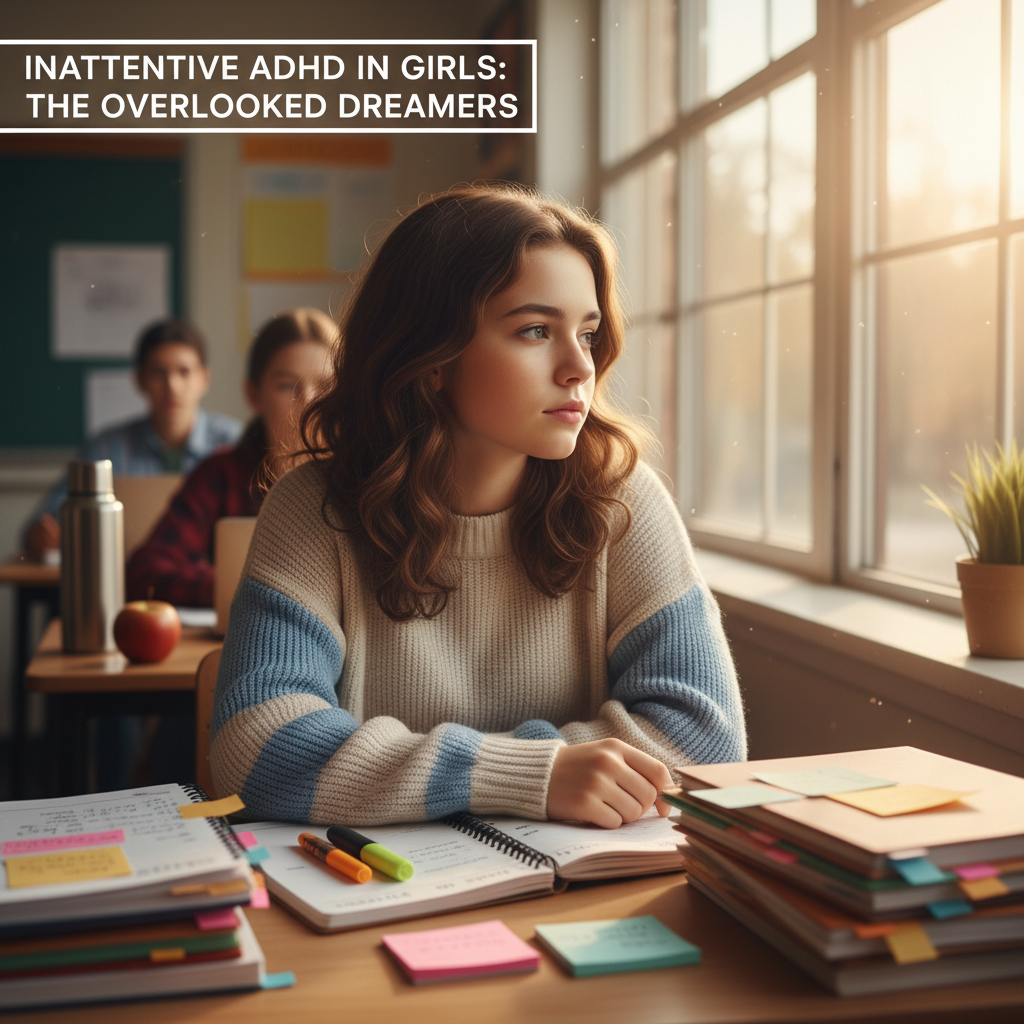
Daydreaming and Inattention
- Seeming “spaced out” or distracted rather than fidgeting or shouting out
- Missing instructions or losing track of conversations
- Appearing to be listening but not processing information
- Staring out the window or “zoning out” during lessons
Over-Compensation
- Using high effort, organisation systems (like my colour-coding) to hide the struggle
- Excessive list-making, planning, and checking
- Staying up late to complete work that should take less time
- Appearing “together” while internally chaotic
Emotional and Social Difficulties
- Rather than purely behavioural ones: anxiety, perfectionism, hiding mistakes
- Heightened sensitivity to criticism or rejection
- Difficulty maintaining friendships or reading social cues
- Emotional dysregulation (crying easily, mood swings)
Masking
- Girls often learn early to “fit in”, suppress impulses, and appear compliant
- This ironically means their ADHD is less likely to be recognised
- Masking is exhausting and leads to burnout, anxiety, and low self-esteem
- The effort to appear “normal” can be overwhelming
Because of this, girls with ADHD often “slip through the net.” They might not be disruptive — they might appear shy or daydreamy — so they go unnoticed.
Statistics:
- Girls are diagnosed with ADHD 3-16 times less frequently than boys (depending on the study)
- Girls are typically diagnosed 5 years later than boys — often not until adolescence or adulthood
- 70% of girls with ADHD have the inattentive subtype, compared to 30% of boys
For more information on ADHD in girls and women, visit ADHD UK or the ADHD Foundation.

Why the Classroom May Miss Them
There are several reasons why girls with ADHD are often overlooked:
Teacher Training and Awareness
- Most training focuses on hyperactivity and external disruption, less on quiet inattentiveness
- Teachers may not recognise inattentive ADHD symptoms as a neurodevelopmental condition
- Lack of understanding about gender differences in ADHD presentation
- Assumption that ADHD always involves disruptive behaviour
Stereotypes and Expectations
- Girls are expected to behave quietly, help others, and conform socially
- When a girl is quiet but struggling, it’s often seen as “shy” or “dreamy” rather than a sign of ADHD
- Cultural expectations that girls should be organised, tidy, and compliant
- Behaviour that would raise concerns in boys is dismissed in girls
High Achievement Masks Needs
- If a girl performs well in tests or keeps up with homework — even through immense effort — her underlying struggles may be missed
- Academic success is seen as evidence that “nothing is wrong”
- The cost of that success (anxiety, exhaustion, burnout) goes unnoticed
- Grades don’t reflect the hours of extra effort required
Emotional Regulation and Co-Occurring Needs
- Girls often experience anxiety, low self-esteem or perfectionism alongside ADHD
- These can overshadow the ADHD itself in assessments
- Depression, eating disorders, and self-harm are more common in undiagnosed ADHD girls
- Mental health symptoms are treated without addressing underlying ADHD
For guidance on recognising ADHD in girls, visit the National Autistic Society (which also covers neurodiversity broadly) or Young Minds.

My Own Experience: The Hidden Struggle
My academic success never felt like victory — it felt like survival. Colour-coded folders, perfect planners, staying up late to make up for lost focus in class. I wasn’t distracted loudly — I was silently panicking: worried I hadn’t written something down, that I’d forget, that I wouldn’t catch on. I wasn’t sent out — but I was exhausted.
What it felt like:
- Constantly worrying I’d missed something important
- Re-reading instructions multiple times to be sure
- Spending twice as long on homework as my peers
- Feeling like I was “faking it” and would be found out
- Exhaustion from maintaining the appearance of being “together”
Because I wasn’t disruptive, I wasn’t flagged. Because my grades ticked along, I wasn’t questioned. And because I hid the struggle, no one saw the cost.
Later I realised: much of that effort was my brain working overtime so I wouldn’t look like I was struggling. I believe many girls do the same.
The cost of undiagnosed ADHD in girls:
- Chronic anxiety and perfectionism
- Low self-esteem and feelings of inadequacy
- Burnout in adolescence or early adulthood
- Difficulty understanding why “normal” things feel so hard
- Late diagnosis (often not until 20s, 30s, or later)

What Parents and Schools Can Do to Support Girls with ADHD
Recognising and supporting girls with ADHD means looking beyond stereotypical behaviour. Here are some practical steps:
Look for Hidden Signs
- Repeated lateness (time blindness)
- Unfinished homework despite good intentions
- Messiness or disorganisation at home (even if tidy at school)
- Perfectionism and anxiety about mistakes
- Emotional sensitivity and mood swings
- Exhaustion after school (masking burnout)
- Difficulty making or keeping friends
Ask the Girl Herself
- “What feels hard? What helps?”
- She may be masking far more than she shows
- Create a safe space for honest conversation
- Validate her experiences without judgment
- Listen to her descriptions of how her brain works
Support Organisation and Executive Function
- Planning tools, visual checklists, and colour-coded systems can help
- But remember: these are coping mechanisms, not cures
- Teach executive function skills explicitly
- Break tasks into smaller, manageable steps
- Use timers, reminders, and visual schedules
Build Emotional Resilience
- Girls often carry guilt or shame about “not being as good as they should”
- Validate effort, not just outcomes
- Celebrate progress and problem-solving
- Teach emotional regulation strategies
- Normalise asking for help
Recognise the Cost of Masking
- A compliant student may be burning out from holding it together
- Offer rest, flexibility, and understanding
- Create opportunities for unmasking in safe environments
- Acknowledge the effort it takes to appear “fine”
Collaborate with Teachers
- Ensure schools recognise that being quiet isn’t the same as coping
- Share information about ADHD in girls with teachers
- Request reasonable adjustments (extra time, movement breaks, quiet spaces)
- Regular check-ins to monitor wellbeing, not just grades
Push for Assessment or Support Early
- Particularly when anxiety or under-the-surface distress is evident
- Don’t wait for academic failure to seek help
- Request ADHD assessment through GP or school SENCO
- Consider private specialist tutoring for immediate support
For support with ADHD assessment and diagnosis, visit ADHD UK or Psychiatry UK.

The Empowerment Path: From Over-Compensation to Thriving
Recognition isn’t just about diagnosis — it’s about empowerment. For girls who mask, the goal isn’t simply to “catch up” but to understand themselves. To embrace how their brain works and learn how to thrive, not just survive.
What empowerment looks like:
- Self-awareness: Understanding your ADHD brain and how it works
- Self-compassion: Letting go of shame and perfectionism
- Self-advocacy: Asking for what you need without guilt
- Strength-based thinking: Celebrating ADHD strengths (creativity, hyperfocus, resilience)
- Sustainable strategies: Finding systems that work for you, not against you
At Minariel Tutors, we believe being different isn’t a flaw. Colour-coding your notes? That’s creativity. Double-checking your planner? That’s resilience. The aim is to help every neurodivergent learner — especially girls — find self-trust and confidence, not perfectionism.
You don’t need to look like the stereotype to have ADHD. If you’ve been the quiet, high-achieving girl who hides her struggles behind organisation and effort — you’re seen, and you’re not alone.

Frequently Asked Questions
How do I know if my daughter has ADHD?
Signs of ADHD in girls include:
- Daydreaming or appearing “spaced out”
- Difficulty focusing on tasks or conversations
- Forgetfulness and losing things
- Disorganisation (even if hidden)
- Anxiety, perfectionism, or emotional sensitivity
- Exhaustion from trying to “keep up”
- Difficulty making or maintaining friendships
If you notice these patterns, speak to your GP or school SENCO about an ADHD assessment.
Why are girls with ADHD diagnosed later than boys?
Girls are diagnosed later because:
- They’re more likely to have inattentive ADHD (less obvious than hyperactivity)
- They mask their symptoms to fit in
- Teachers and parents expect girls to be quiet and compliant
- Academic success hides underlying struggles
- Anxiety and emotional symptoms overshadow ADHD
Can high-achieving girls have ADHD?
Absolutely. Many girls with ADHD are high-achievers who work twice as hard to maintain grades. Their success comes at a cost: anxiety, exhaustion, and burnout. Academic performance doesn’t rule out ADHD.
What is masking in ADHD?
Masking is when someone with ADHD hides their symptoms to appear “normal.” Girls often mask by:
- Suppressing impulses
- Over-organising to compensate
- Copying peers to fit in
- Hiding mistakes or struggles
Masking is exhausting and leads to burnout, anxiety, and low self-esteem.
How can I support my daughter with ADHD?
Support strategies:
- Validate her experiences and feelings
- Help with organisation (visual schedules, checklists, timers)
- Teach emotional regulation skills
- Advocate for school adjustments
- Seek specialist ADHD tutoring for tailored support
- Encourage self-compassion and strength-based thinking
Can private tutoring help girls with ADHD?
Yes!Specialist ADHD tutoring provides:
- 1-to-1 support in a calm environment
- Teaching tailored to ADHD learning styles
- Executive function coaching
- Confidence building and emotional support
- Understanding from tutors who “get it”
If This Resonates with You or Your Child, We’d Love to Help
At Minariel Tutors, we support neurodivergent learners — including girls and young women with ADHD — through patient, tailored tutoring that celebrates strengths and builds confidence.
Our ADHD tutoring for girls includes:
- 1-to-1 specialist support tailored to inattentive ADHD
- Executive function coaching (organisation, planning, time management)
- Emotional regulation strategies and confidence building
- Strength-based teaching that celebrates creativity and resilience
- Understanding from tutors who have lived experience of ADHD
Both our co-founders have ADHD — we understand the hidden struggles because we’ve lived them.
Book Your Free Consultation Today
Let’s discuss how we can support your daughter’s ADHD journey.
Book Free Consultation | View Our ADHD Tutoring Services | Contact Us
Email:minarieltutors@gmail.com